Portrait story / Britannia Beach, Ottawa
After Light.
She came to the session believing she was not photogenic. The photograph did not need to prove her wrong. It needed to give her enough space to stop trying to be right.

01 / Intent
A portrait without a test.
Some people arrive in front of a camera already preparing to dislike the result. They become aware of every expression, every angle and every second that passes between frames.
This session began there.
The intention was not to manufacture confidence or turn her into a different person. It was to make the camera feel less like a test—to create a portrait in which she could be still, uncertain, amused and fully present without having to perform any of it correctly.
Encouragement, in this case, did not mean asking her to believe she looked beautiful. It meant giving her something more immediate to believe in: the light, the water, the next small movement and the person behind the camera paying attention.
02 / Conditions
Working between daylight and blue hour.
We photographed at Britannia Beach in Ottawa, beginning near sunset and continuing into blue hour. The water held both colours at once: soft peach on the surface and deeper blue underneath.
That transition gave us a narrow visual window. The light was changing quickly, but rushing would have brought the self-consciousness back into the session. Instead, the pace stayed quiet. The shifting colour became part of the portrait rather than a problem to control.
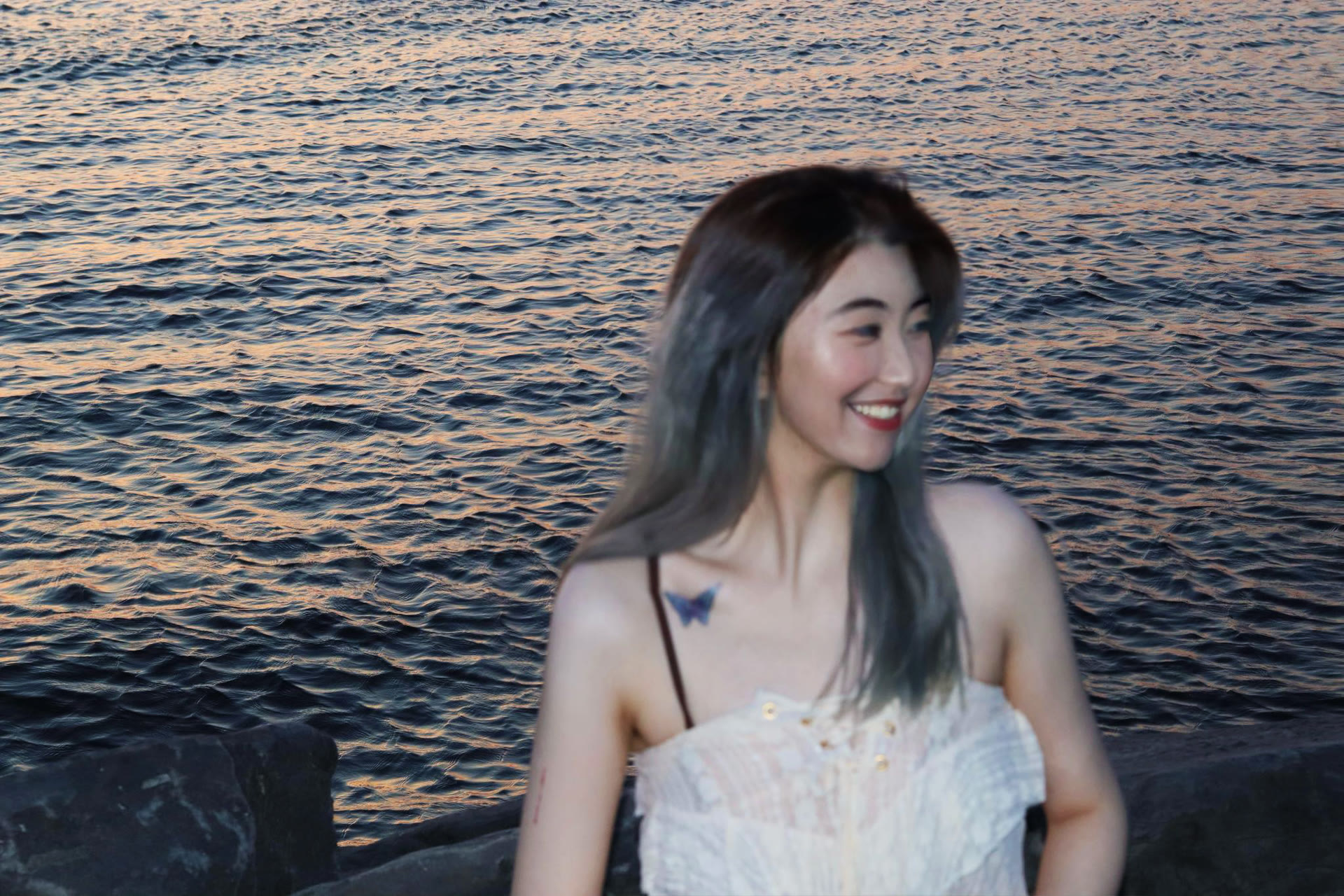
Her pale clothing reflected what remained of the evening light, while her darker hair and the water gave the photographs their depth. The small butterfly near her collarbone became an unexpected point of colour—almost a second subject inside the frame.

03 / Direction
Something to do, not a pose to hold.
Rather than building the session around a list of poses, I used small changes of attention: look toward the water, turn back slowly, let the hair move, pause before finding the lens.
The direct portraits came from stillness. The smiling frame came from the moment between instructions, when her attention moved away from the camera and the expression no longer needed to be arranged.
That slight softness matters. It keeps the photograph from becoming a demonstration of perfect technique or perfect appearance. It feels like a moment that continued moving after the shutter closed.
04 / Finish
Being seen without becoming someone else.
The finished series moves between two ways of being seen. In one, she meets the camera directly—quiet, composed and surrounded by the colour of the water. In another, she turns away and smiles, briefly released from the idea that every frame must be controlled.
The point was never to produce evidence that she had been wrong about herself.
A portrait cannot settle that argument permanently. What it can do is interrupt it. It can preserve one evening when the camera felt less judgmental, the light was generous, and being photographed did not require becoming anyone else.